Faux finishing marble and wood grain by Phoenix artisans
Many have asked about our process over the years so this page was created to demonstrate some of our techniques.
|
 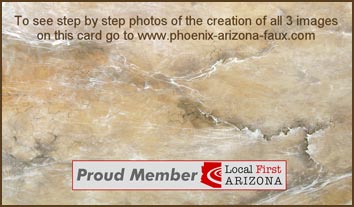 |
| All of these sample boards were created for the purpose of being photographed for the East Coast Custom Faux Finishing, LLC business card (pictured above) but over 200 sample boards from previous jobs are available to be viewed for consultations in the Phoenix Arizona area. Below is the marble pictured on the rear of the business card. |
a1- 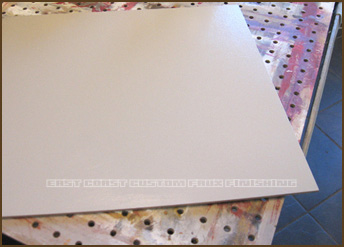 a2- a2- 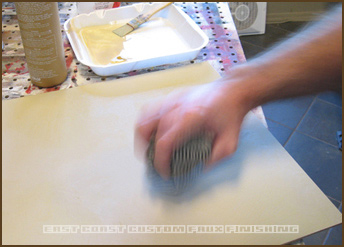 |
a1-Good working habits and consistency are essential to performing quality work so every job is begun on a solid, opaque base coat to insure a professionally finished look.
a2-In the second step a lighter, cooler color is brushed on then its edges are worked back and forth with a damp rag for style and affect. This is more of a sketching process, used to map out what will go in the different areas. Some of the best finishes require a very subtle start and slow build up of the surface. One of the most important, and neglected practices of many other faux finishers in the Phoenix area is understanding how the subtle differences in warm and cool colors and layering of these can create far greater depth than re-texturing a surface or the opaque sponging of colors many other faux finishers rely on. |
a3- 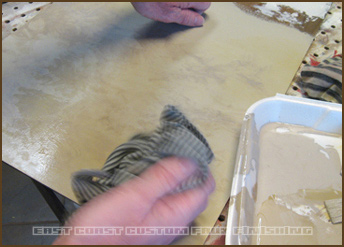 a4- a4- 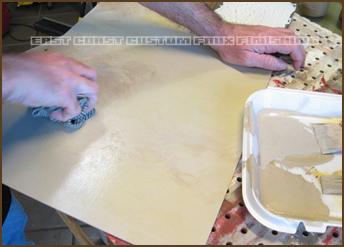 |
| a3, a4, a5-A medium value grey, about two shades darker, and cooler than the base is brushed on then sculpted with specifically bunched up rags to create a broken glass or quartz like texture. Note the Styrofoam mixing trey....this job often requires eating a great deal of take out food. |
a5-  a6- a6- 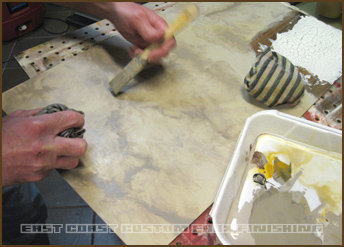 |
| a6-To create depth, darker areas are added. These are similar to the veins that will be added later. The borders of these areas are then molded with a damp rag. Pushing in a lifting up fashion that is almost impossible to explain but requires just the right downward push then a quick picking up at a 45 degree angle to achieve a specific look and form. The crackle sample in the upper right from another set of samples/ideas, I am always tinkering with something. |
a7- 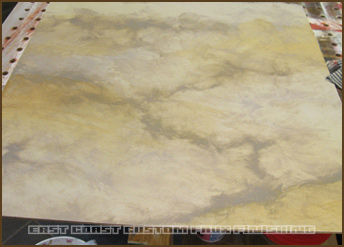 a8- a8- 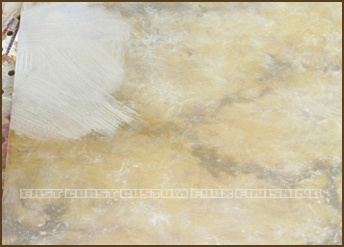 |
a7-Here a very thin and transparent sienna tinted glaze has been brushed on then worked with rags creating a similar but more flattened quartz texture. Almost like an old paper bag. This is used to create depth with some warmth to oppose the cooler areas.
a8-In this stage a half paste is created then brushed on. This is then lifted off with a very specific bunching and sweeping motion of the rag. A half paste is something that has been used since the days of the classical oil painters. It is essentially how it sounds, a thick glaze, usually employed with a reductive method, brushed on to be lifted off in areas to partially expose the under painting. |
a9- 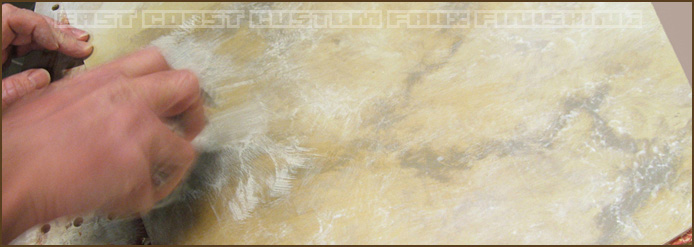 |
| a9-The reductive process in action. You can see the finished effects of this half-paste in the upper right corner of a-9. |
a10- 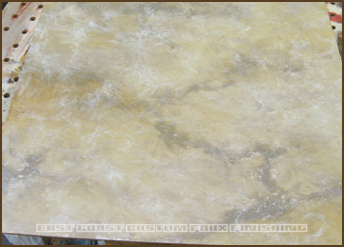 a11- a11- 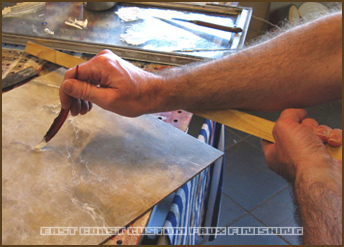 |
a10-The finished foundation, before the veins and cracking effects are added.
a11-Feathers have been used for ages to paint expressive lines that go from thin to thick and back in one single stroke. They can hold large amounts of paint (in liquid form) and distribute it evenly if desired or if wanted with the turn and twist of the feather dispersing the colors in a calligraphic style line. A stick, or what is sometimes called a “malstick” is used to steady the hand as it is slowly and deliberately hovered over the working surface. |
a12- 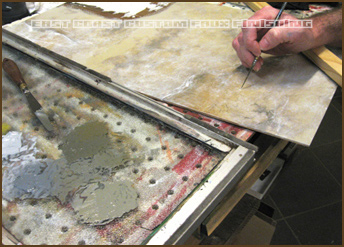 a13- a13- 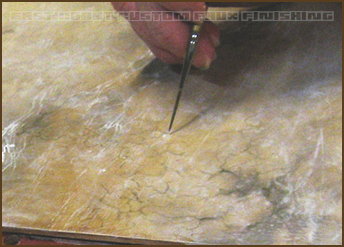 |
| a12, a13-The details are filled in with a Rigger or Liner brush. These have very long, thin bristles. The best of these brushes are natural/non-synthetic bristles because of their firmness in creating steady, highly controlled lines. |
| Below is the Wood Graining sample board pictured behind the business name. |
b1- 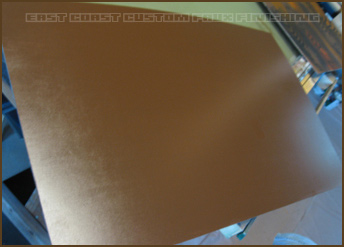 b2- b2- 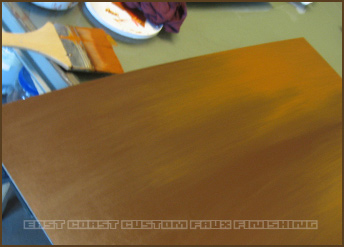 |
b1-First a custom tinted color is painted in a consistent even coat. Here a simple piece of masonite is used but this process, like any of finishes, can be over any paintable surface.
b2-Then a second color is painted to add depth. This is brushed over a clear gel, glaze so the opaque orange can be blended into a wet on wet smooth blend. This clear glaze is something that is made uniquely for each job and used often for a professional blended look. Every color used is specially tinted for each job. |
b3- 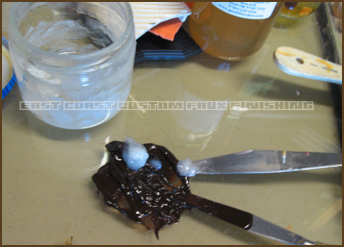 b4- b4- 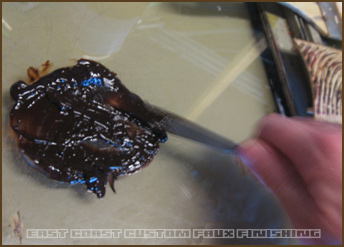 |
| b3 and b4-I wont lie to you decades of experience has taught me the use of a wide variety of materials to create a wide range of effects. Here ingredients are mixed to create a thick, opaque paste that is slow drying and easy to manipulate while still stiff enough to hold its body long enough to dry in the molded texture created by the rubber tool pictured below. Supplies collected from art supply stores, house paint stores as well as ingredients from the internet that are used to create products sold in both of these stores are employed on most jobs. |
b5- 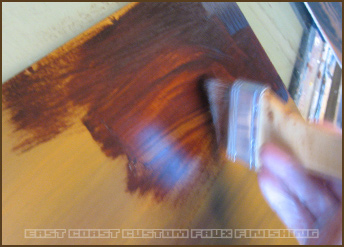 b6- b6- 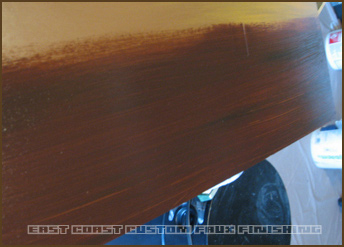 |
b5-This material, which is unique to this look and style of wood is painted on, in this case spreading almost like a tar.
b6-Here the glaze is brushed evenly waiting to be textured. Every type of wood requires a different type of glazing paste, sometimes thick or thin. Part of the services offered by East Coast Custom Faux Finishing is fashioning specific looks to each client. This means being flexible and knowledgeable about this and many other faux finishing processes. |
b7- 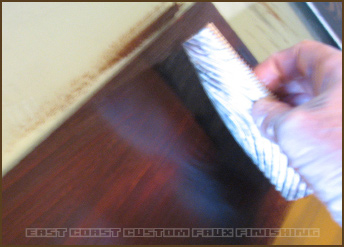 b8- b8- 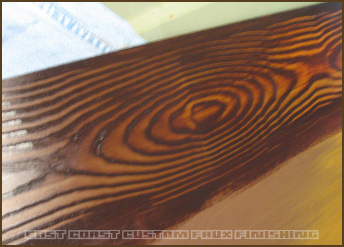 |
b7-In this case a rubber tool is dragged while rocking up and down to create the semicircular pattern of this type of wood.
b8-After years of practicing I have learned many tricks and developed methods using all sorts of materials. |
b9- 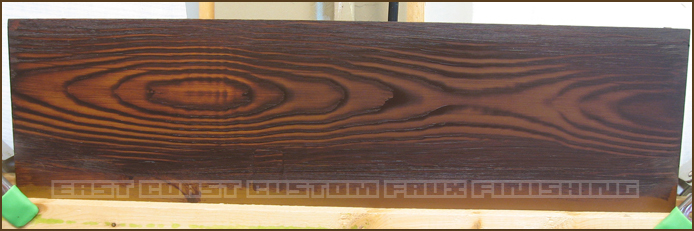 |
b9-Cleaned up and on its perch ready to be photographed. Some of the detail along the top and bottom right sides can not be seen due to the glare of the Phoenix sun.
Take a look at some of these other examples of wood graining from recent jobs here.
Below is the marble on the top front of the card. |
c1- 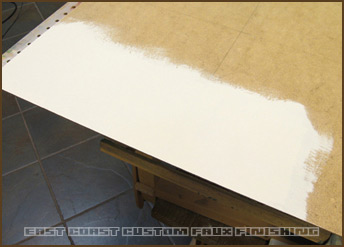 c2- c2- 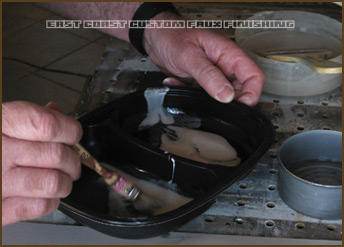 |
c1-This one was begun, for a change, on a fresh piece of sanded masonite. As opposed to many of the other hundreds of boards that are continually sanded and repainted with samples for each new job. In this case a flat paint was used as a base to achieve a different effect than the low sheen used in the marble above.
c2-All of the colors are specifically tinted and planned out ahead of time leaving very little to chance. Randomness is not an option when performing multi-layerd faux finishing of this nature. I have stacks of frozen food containers....I eat a great deal of frozen diners. |
c3- 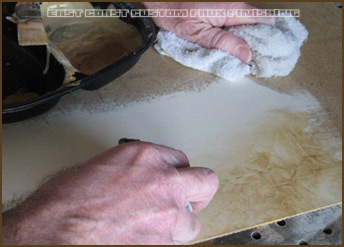 c4- c4- 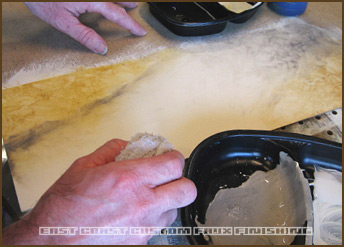 |
c3-A specially tinted glaze is brushed on then worked in a reductive technique to create a quartz-like textured effect. This is intentionally much darker than the finished look because of all of the lighter translucent layers planned for the upper layers.
c4-Additional layers of glaze are applied then worked back and forth to create different textures. Here you can see a different type of rag was used than the first marbles effect. The flat base colors will create deeper, richer colors than semi-gloss paints because the flat absorbs what is put over it while the gloss leaves most of the glazes to be reduced with rags. Working over the flat base requires a rougher, more aggressive manipulation of the glazes. I have a full range of fabric bolts from 100% synthetic to all natural cottons and wools in my Phoenix workshop. It is always important to be prepared and well versed in as many working materials as possible. |
c5- 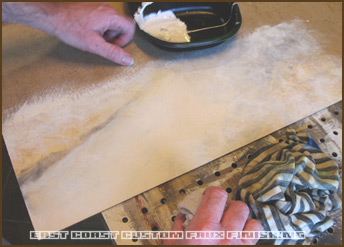 c6- c6- 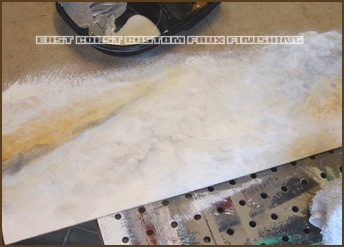 |
c5-One of the signs of a faux finisher who understands color is being able to create depth utilizing shifts in temperature or saturation content (purity of color). The first of the lighter layers, a half paste is applied, in addition to a higher value (lighter) it is also much cooler to give more of a three dimensional effect. As the upper layers of glaze are applied the surface becomes more toolable (easily worked) so thinner, more delicate, synthetic rags are use giving more control over creating subtleties in the texture. About 95% of the darker colors are covered up with the lighter colors. But since the lighter, cooler layers are translucent the darker, warmer colors peak through creating a three dimensional effect that can not be achieved with opaque paints or “sponge” like faux finishing techniques.
c6-Here the lights are complete. Unfortunately these photos were all taken from a distance that the details are not very clear. |
c7- 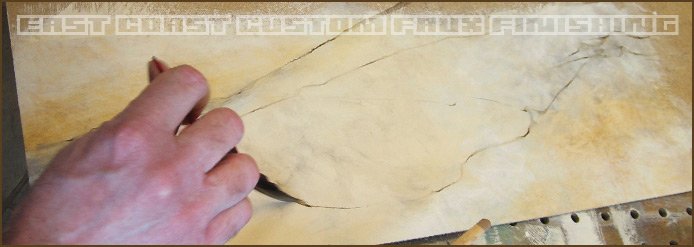 |
| c7-The veins are placed in the composition with a series of feathers, here an alkyd (or oil) glaze is used to give a slower drying time because once the lines are put in they are worked back and forth with rags to create a three dimensional effect thus “creating” cracks. |
c8- 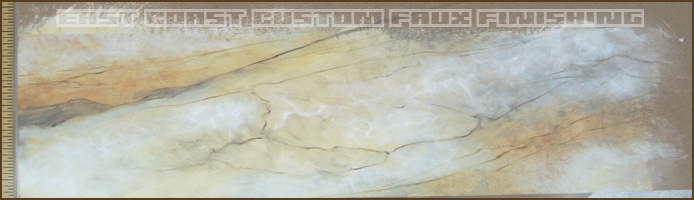 |
c8-After photographing and reducing the image to the 12x90 millimeter area of the business card, the marble was not striking enough so more whites are added later with a cooler blueish hue to create better depth. After photographing the dimensions had to be adjusted from a 1 to 5 ratio to a 1 to 6 ratio (squeezed) to fit into the thin band of the business card.
Contact us at 602-296-4551 or info@eastcoastcustomfauxfinishing.com
or take your time and browse our website. The Portfolio page contains several of our past jobs. Plus there are additional links to other jobs through the photo links on our other pages. The narrow images to the right are links to other job pages. Plus the Samples page contains a small amount of the 200 sample boards in the ECCFF catalogue.
|
|
|
Any style of work is available. A small list of some of our specialties including marble, leather finishing, woodgraining, suede painted finishes, custom matching of outlet covers, repairs to other faux painters work, essentially the custom painting of any paintable surface.
Beware of unlicensed faux finishers.
Maricopa County faux finishers are known for giving low initial prices only to raise them for the final bill. ECCFF is fully licensed and answers to the state Register of Contractors. So you can be assured that the prices given during the initial consultation will remain unchanged unless additional work is added.
Another mistake many faux finishers make is not knowing the importance of proper preparation of the surface. If a price for decorative painting seems too low to be true be sure to ask what sort of preparation the contractor is planning on. Without proper preparation and priming it does not matter how good the final project looks it may not last.
Phoenix, Arizona faux finishing specializing in ceilings, walls and woodwork. All styles of custom faux finishing including custom marble columns, woodgraining, old world faux finishes, faux leathers and many more. Our choice of styles is only limited by your imagination.
|